
NSF POSE TEAM 4373
Who we are

Max Ghenis
Co-Founder & CEO
MIT M.S. Development Economics
Former Google
Founded UBI Center

Pavel Makarchuk
Chief of Staff
Operations & strategy lead
Led development of US state-level
tax-benefit model

Daniel Feenberg
Advisor
Princeton Ph.D. Economics
Former IT Director at NBER
Created TAXSIM
Together we've built the most widely used open-source tax-benefit microsimulation platform in the US and the UK.
Trusted by
10 Downing Street · US Congress
Brookings · NBER · Atlanta Fed · Niskanen Center · Living Wage Institute · Bureau of Economic Analysis
THE PROBLEM
You want to expand the child tax credit. Now what?
Ask Congressional Budget Office
Gatekept and slow
- Not on Ways & Means or Senate Finance? Good luck.
- Months-long queue, even for top committees
- Usually just a budget number — no winners/losers breakdown
Commission a study
Expensive, black box, one-shot
- $10K+ per analysis from a think tank or consultant
- Proprietary models you can’t inspect or adjust
- Others can’t critique or iterate on your proposal
DIY
Uncertain, not credible
- Tax and transfer policy is enormously complex
- Back-of-envelope won’t match CBO’s eventual score
- No external credibility for your numbers
This is a state capacity problem: governments can't analyze their own policy options fast enough.
THE OPPORTUNITY
What if there was a fourth option?
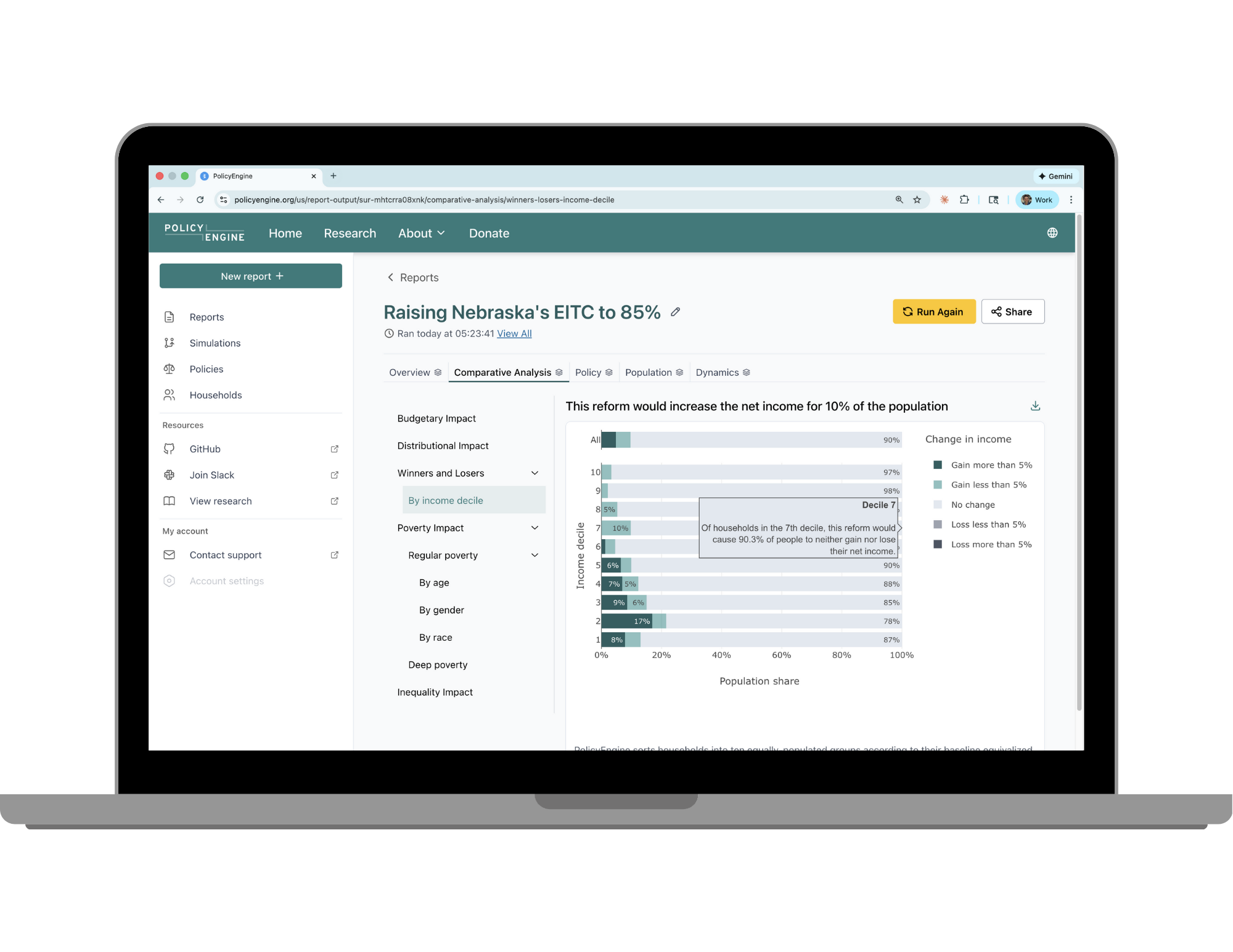
> What if we raised the standard deduction to $20,000?
Running microsimulation on 2024 Enhanced CPS...
Cost: $80B · Winners: 62% · Gini: −0.001
Use PolicyEngine — free and instant
Microsimulation models for the US and the UK that anyone can run — no gatekeepers, no wait, fully auditable.
Web app
Interactive calculators at policyengine.org
Python package
Full programmatic access for researchers
REST API
Integrate into any application
AI interfaces
Natural language via Claude
INSPIRATION
The Human Genome Project created an ecosystem
One foundational investment — sequencing the human genome — unlocked an entire ecosystem of computation and application that generated $796B in economic value from a $3.8B investment.
Foundation
Encode the raw material
Human Genome Project
Sequenced all 3 billion base pairs of human DNA into an open, machine-readable reference genome
Computation
Build models on the data
DeepMind / AlphaFold
Predicted 3D structures for the entire human proteome cataloged by HGP
Schrödinger
Molecular simulation on open structural data
Broad Institute
Open-source genomic analysis tools (GATK, Terra)
Application
Bring it to people
23andMe
Made genomics personal — millions of consumers explore their own DNA using open genome data
Moderna
mRNA therapeutics from genomic insights
Illumina
Sequencing hardware
Source: Battelle Technology Partnership Practice, “Economic Impact of the Human Genome Project” (2011). Figures represent 1988–2010 federal genomic research investment and resulting economic activity.
OUR WORK
PolicyEngine across the policy stack
When we started PolicyEngine, the goal was to provide the computational layer. Over time we found ourselves expanding into encoding the rules themselves and building the research and tools that bring policy to life.
Foundation
Encode the raw material
We encode public policy
160,000+ pages of federal tax code, 50 state systems, and 100+ benefit programs — translated into open-source, machine-readable rules.
Computation
Build models on the data
We develop simulation models
Run encoded rules against representative survey data to model how policy changes affect every household in the country.
Application
Bring it to people
We conduct research and build tools
Produce reports, analysis, and applications that bring policy to life — used by policymakers, journalists, and researchers.
Today the alternatives cost $10K+ per license, take weeks, and can't be audited. PolicyEngine is free and open.
IMPACT
PolicyEngine by the numbers
Used by















THE JOURNEY
100 conversations
We brought a hypothesis to POSE: PolicyEngine should become an ecosystem of specialized organizations. We’d already pitched a three-org vision to investors that same week. Now we had to pressure-test it.
Speed + open source + prototyping is our edge, but encoding is fast while review/debugging is the bottleneck.
— Nikhil Woodruff
CTO
Think tanks and researchers confirmed demand. The week before, we’d published our 10 Downing Street work—PolicyEngine was already in government.
Fast, open tools are especially valuable for quick turnaround vs. slow official scores.
— Andrew Lautz
BPC
Government standards bodies and AI + econ researchers kept surfacing. Each needed something different from us.
Most leverage is upstream: getting legislative drafters to author executable rules early.
— Jason Morris
Thomson Reuters
Government standards bodies and AI + econ researchers kept surfacing—adjacent ecosystems with parallel needs, just as we had hypothesized.
VALIDATION
Testing the hypothesis
Every conversation reinforced the pattern: different audiences need different governance, funding models, and technical architecture.
Institutions like the Fed face strong IT/security barriers to external APIs — installable, low-dependency tools fit much better than cloud services.
— Jacob Walker
Sr. Research Analyst, Atlanta Fed
PE-style tools are ready for deployment; the blocker is institutional slowness, not technology.
— Martin Perron
Rules as Code, Canadian Digital Services
Government agencies needed one thing. AI + econ researchers needed another. Funders wanted a third. Every interview confirmed the pattern we hypothesized.
VALIDATION
Hypothesis validated
The ecosystem vision was resonating beyond our interviews. Funders and foundations were engaging.
Researchers adopt OSS if accessible
But they also need validation against official sources before they'll cite it.
Funders value transparency enough to fund OSS
One grant funds infrastructure used by multiple orgs — leverage argument works.
Developers contribute for policy impact alone
They also need portfolio value, learning opportunities, and community.
One organization cannot serve all segments
Our pre-POSE hypothesis confirmed: infrastructure, standards, and research need different governance and funding.
Data and rules complexity create big gaps where better microsim tools are still missing.
— Jack Landry
Jane Family Institute
OUR WORK
PolicyEngine across the policy stack
When we started PolicyEngine, the goal was to provide the computational layer. Over time we found ourselves expanding into encoding the rules themselves and building the research and tools that bring policy to life.
Foundation
Encode the raw material
We encode public policy
160,000+ pages of federal tax code, 50 state systems, and 100+ benefit programs — translated into open-source, machine-readable rules.
Computation
Build models on the data
We develop simulation models
Run encoded rules against representative survey data to model how policy changes affect every household in the country.
Application
Bring it to people
We conduct research and build tools
Produce reports, analysis, and applications that bring policy to life — used by policymakers, journalists, and researchers.
Today the alternatives cost $10K+ per license, take weeks, and can't be audited. PolicyEngine is free and open.
THE INSIGHT
Each layer needs a dedicated organization
100 conversations confirmed it: different audiences need different governance, funding models, and technical architecture. One organization genuinely cannot serve all three layers well.
Foundation
Encode the raw material

A nonprofit dedicated to encoding tax and benefit rules into open, machine-readable code.
Focused governance for government partnerships, standards bodies, and legislative drafters.
Computation
Build models on the data

A commercial platform building simulation APIs on open rule encodings.
Revenue-generating model enabling enterprise customers, certified partners, and SaaS products.
Application
Bring it to people
The research and public-facing layer — bringing policy to life for individuals and society.
Continues the mission: free, open analysis for policymakers, journalists, and researchers.
Three organizations. Each specialized. Each stronger for the separation. Connected by shared open-source code.
THE THREE ORGS
Meet the three

Rules Foundation
Encoding the world’s rules
The HGP for rules · Open reference layer
Revenue
- Government grants
- Foundation grants
- AI lab in-kind (compute)
- Downstream contributions
Programs and tax rules in silos create severe unintended consequences — cliffs, penalties. Modeling these is influencing legislators.
— Ray Packer
Georgia Center for Opportunity

Cosilico
Society in silico
Society in silico · Like Schrödinger for policy
Revenue
- Open source (free, Apache 2.0)
- API: $0.001–0.01/call
- Data enrichment: $0.10–1.00/record
- Enterprise: $100K–1M+/year
Data and rules complexity create big gaps where better microsim tools and infrastructure are still missing.
— Jack Landry
Jane Family Institute

PolicyEngine
Policy meets evidence
Like IHME for economic policy · Open source
Revenue
- Foundation grants
- Government grants (NSF)
- Earned revenue
Think tanks want auditable methodology they can cite in publications.
— Think tank interviewees
THE ECOSYSTEM
One became three
This was us going in. One organization serving researchers, government agencies, AI + econ researchers, and funders. We hypothesized this couldn't scale.
PolicyEngine serves all user segments as one organization
TIMELINE
The road ahead
Q1 2026
Q2-Q3 2026
Q4 2026
2027
2028
- POSE complete
- 100 interviews validated 3-org structure
- Ballmer Group engaged
- Incorporate
- Begin US tax encodings
- Complete US tax & benefit encodings
- UK encodings
- 5+ agency partnerships
- Self-sustaining operations
- Incorporate
- Rules API launch atop RF
- Simulation API launch
- First paying customers
- $3M ARR
- 50+ media citations
- 5 published reports
- 100+ citations
- 3 research partnerships
- 500+ citations
- 10+ institutional partners
- Authoritative source for policy analysis
The Human Genome Project didn't just map DNA. It created an ecosystem—Schrödinger built computational simulation on open molecular data, IHME built the Global Burden of Disease on open health data. Cosilico and PolicyEngine do the same for economic policy—simulation and research on Rules Foundation's open rules.
We're building the same thing for the rules that govern American life. Our technology is already in use at 10 Downing Street. Major foundations are engaging. 100 interviews confirmed the vision. Now we're ready to build.
Rules Foundation
Encoding the world’s rules
Cosilico
Society in silico
PolicyEngine
Policy meets evidence
We hypothesized an ecosystem. 100 interviews proved it. Now we're building it.
Looking for
Appendix
VOICES FROM THE FIELD
What practitioners told us
Institutions like the Fed face strong IT/security barriers to external APIs — installable, low-dependency tools fit much better than cloud services.
— Jacob Walker
Sr. Research Analyst, Atlanta Fed
PolicyEngine-style tools are ready for deployment; the blocker is institutional slowness, not technology.
— Martin Perron
Rules as Code, Canadian Digital Services
Programs and tax rules in silos create severe unintended consequences — cliffs, penalties. Modeling these is influencing legislators.
— Ray Packer
Georgia Center for Opportunity
Data and rules complexity create big gaps where better microsim tools and infrastructure are still missing.
— Jack Landry
Jane Family Institute
Appendix
IMPACT GOALS
IF/THEN: how we'll know it's working
How our thesis evolved
Week 2: If this 1 Senate Bill cites PolicyEngine → unlock direct government contracting
Week 3: If 10 congressional bills cite PolicyEngine → public deserves open policy estimates
Rules Foundation
IF
If one AI lab evaluates its models against Rules Foundation benchmarks
THEN
It will provide society a shared, verifiable standard for legal code interpretation
Cosilico
IF
If one state agency replaces a proprietary vendor with Cosilico Rules
THEN
It will prove that government will invest in open-source rules infrastructure
PolicyEngine
IF
If 20 researchers use PolicyEngine in published papers
THEN
It will prove that open-source tools can replace proprietary licenses in policy research
Appendix
STRATEGIC PARTNERS
Who we need and why
AI + Econ Researchers
Research + Validation
AI-economics researchers across institutions
Value
- • Verifiable ground truth for AI policy reasoning
Risk
May build bespoke tools internally
Policy Foundations
Funding + Community Support
Arnold Ventures, Pritzker
Value
- • Higher-quality policy research
- • Full transparency
- • One grant funds infra used by many orgs
Risk
Foundation priorities shift with leadership cycles
Major Think Tanks
Distribution + Funding
Brookings, CRFB, Niskanen, Urban
Value
- • Expert modeling without internal capacity
- • Auditable methodology for publications
- • Fast turnaround
Risk
Could build in-house from open-source
Appendix
ECOSYSTEM CANVAS
Who we talked to and what they value
Community Members (56 interviews)
- PE Team: 10 — Build core models
- Academic Researchers: 18 — Empirical questions
- Government Economists: 7 — Validate estimates
- Think Tank Analysts: 12 — Policy reports
- OSS Contributors: 4 — Code, fix bugs
- Data Journalists: 5 — Fact-check, interactives
Other Stakeholders (44 interviews)
- AI + Econ Researchers: 10 — AI + policy research
- Funders: 10 — Fund development
- Non-Users: 8 — Understand barriers
- Gov Standards Bodies: 7 — Interoperability
- Policy Advocates: 6 — Shape narrative
- Competitors: 3 — Ecosystem mapping
Value Propositions
- Transparency: Audit every calculation
- Speed: Seconds vs. weeks
- Cost: Free vs. $10K+ licenses
- Integration: API for existing workflows
- Credibility: Validated vs. IRS, SSA, CBO
Appendix
BUSINESS MODEL
Revenue models per organization
501(c)(3)
~$300K/year
Public Benefit Corp
$500K → $75M ARR over 5yr
501(c)(3) / Charity
~$500K/year
GOVERNANCE
How we'll govern it
Before
BDFL model
- Founder makes all strategic decisions
- Single 501(c)(3) owns everything
- AGPL-3.0 license, informal governance
After
Three orgs, tailored governance
- Rules Foundation: multi-stakeholder 501(c)(3)
- Cosilico: Public Benefit Corp, board mandate
- PolicyEngine: 501(c)(3) + advisory board
Rules Foundation
- Multi-stakeholder 501(c)(3)
- Technical steering committee + encoding standards board
- Partisan neutrality · Mandatory statute citations · Multi-reviewer validation
- Historical versioning of all encodings
Cosilico
- Public Benefit Corp (mission-locked by charter)
- Board with public benefit mandate
- Open-source core (Apache 2.0) · Enterprise services layer
- Certified partner program (Salesforce model)
PolicyEngine
- 501(c)(3) / UK Charity (AGPL licensed)
- Founder-led → Technical steering committee + Advisory board
- Contributor guidelines · Formal research partnership agreements
- Open roadmap with community input
Each org has governance designed for its mission. A standards body needs neutrality. A company needs speed. A research org needs independence.
WHAT INTERVIEWS TOLD US
“Fresh entity strongly recommended — you want this fresh start with clean governance from day one.”
— Foundation governance advisor
Jason Morris, Martin Perron, and foundation advisors all pointed to separation of concerns.
Appendix
GOVERNANCE DETAIL
How each organization is governed
Multi-stakeholder 501(c)(3)
- Technical steering committee
- Encoding standards board
- Partisan neutrality requirement
- Mandatory statute citations
- Multi-reviewer validation
- Historical versioning of all encodings
Public Benefit Corp (mission-locked)
- Board with public benefit mandate
- Open-source core (Apache 2.0)
- Enterprise services layer
- Certified partner program (Salesforce model)
- Mission locked by charter
501(c)(3) / UK Charity (AGPL)
- Founder-led → Technical steering committee
- Advisory board from interview network
- Contributor guidelines
- Formal research partnership agreements
- Open roadmap with community input
Appendix
COMPETITIVE LANDSCAPE
How we compare
| Competitor | Key metric | Limitation |
|---|---|---|
| Column Tax | $26.8M raised | Filing, not calculation |
| Symmetry | 64M+ employees/yr | Payroll tax only |
| Benefit Kitchen | 7 states | 18 programs, healthcare focus |
| Avalara | Acquired $8.4B | Sales tax only |
| IMPLAN | Acquired $100M+ | I-O multipliers, no household rules |
PolicyEngine's differentiation
Appendix
INTERVIEW HIGHLIGHTS
Key insights from 100+ conversations
Nikhil Woodruff
CTO, PE
Speed + open source + prototyping; encoding fast but review/debugging bottleneck
Jason Morris
Thomson Reuters
Most leverage is upstream: getting legislative drafters to author executable rules early
Jacob Walker
Atlanta Fed
Fed faces IT/security barriers to external APIs; installable tools fit better
Martin Perron
Canadian Digital Services
PE-style tools ready for deployment; blocker is institutional slowness
Ray Packer
GA Center for Opportunity
Programs in silos create cliffs/penalties; modeling these influences legislators
Paul Huntsberger
Amplifi
DMN-style rule engines were overkill; PE needs faster staged responses
Andrew Lautz
BPC
Fast open tools especially valuable vs. slow official scores; state-level data priority
Kavya Vaghul
Living Wage Calculator
Users want more granular local data; demand for 'thriving wage' concept
John Ricco
Yale Budget Lab
Strong demand for AI research; humans no longer writing code; tariffs + childcare focus
Alejandro Basalo
MSNBC
Timing and momentum matter; household examples anchor reporting
Jack Landry
Jane Family Institute
Custom microsims for deep accuracy; PE for quick first-pass analyses
Thomas Cintra
Outtake
AI compresses dev cycles; ship to learn, not to perfect
Appendix
MARKET SEGMENTS
$250B+ total addressable market
$250B+
Total addressable market (Cosilico)